
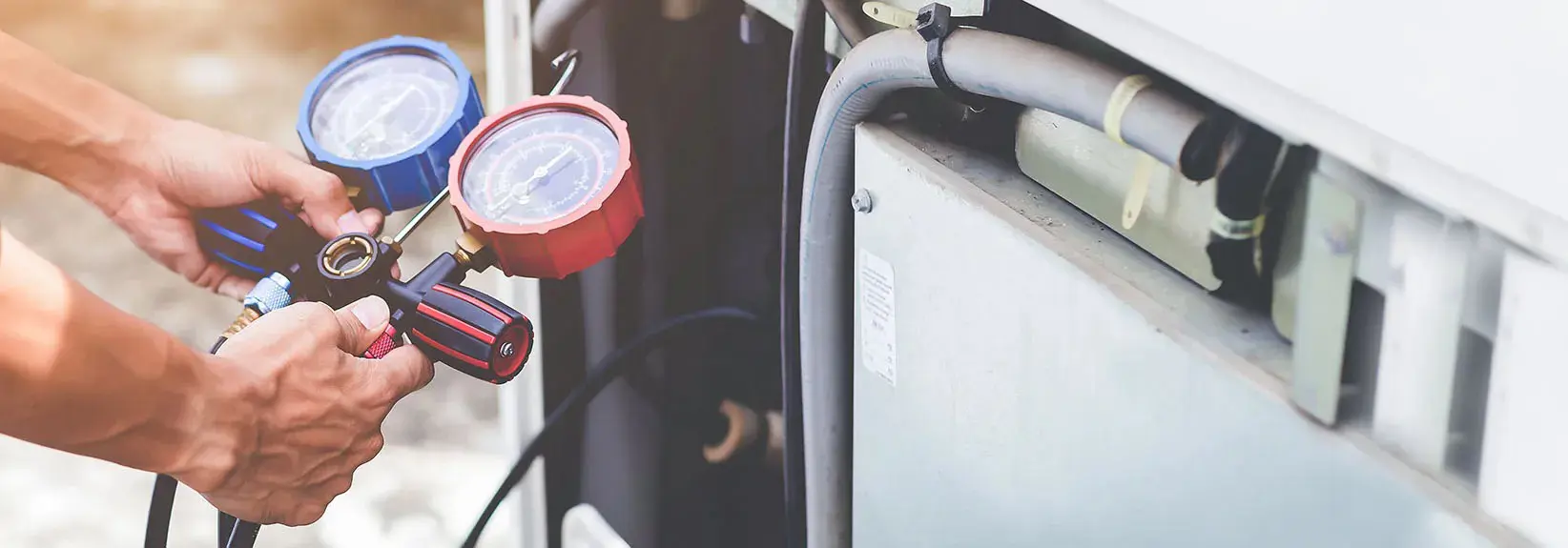
When your home’s AC system malfunctions, you want to get the situation dealt with at the earliest opportunity. Unfortunately, there could be hundreds of reasons why your AC unit isn’t working properly. How do you know which one is impacting you? There are a handful of problems that are more common, and recognizing what they are is beneficial when your Service Experts is going over available choices for solving the problem with air conditioning repair in North America.
Here are the top six common air conditioner problems that can cause your air conditioner to malfunction.
1. Thermostat Problems
Your thermostat tells your AC system when to start and for how long to run. If the settings are wrong, your air conditioning might not work properly. And if the batteries have died in a programmable thermostat, you won't be able to use it at all. Try this short checklist to ensure your thermostat is receiving power and working properly:
- Swap out batteries if the screen is blank (programmable models)
- Make sure your thermostat has power (smart models)
- Check that it’s switched to cooling mode
- Ensure your preferred temperature is below the current room temperature
2. Dirty Air Filter
Dirty or inefficient air filters are infamous for turning a perfectly functional and effective air conditioner into a slow and inefficient one. In addition, dirty filters will sometimes cause lots of problems, including reduced airflow, lower indoor air quality and greater power consumption. They can also make the air conditioning work harder and stop working if the coil freezes.
You can easily avoid AC problems by consistently cleaning or replacing the air filter. How do you know whether you should change your filters? If you can’t recall the last time you changed them, it’s almost surely time to. But for a basic recommendation, make sure you try to exchange flat filters each month and pleated filters every three months.
3. Frozen Condenser Coils
Your air conditioner’s coils are crucial components because they discharge heat from your home into the outdoor air. But even in the middle of the summer, ice can build up on the coils. Frozen coils won’t be able to handle the cooling process as easily, and in some cases sufficient ice can keep the AC from running at all.
Freezing can be linked to several issues, like:
- Dirty coils caused by a lack of annual maintenance
- Dirty air filters, which obstruct airflow
- Clogged drain line, which can trigger moisture buildup
- Refrigerant leaks, which decrease cooling power
If your air conditioner is frozen, Turn it off and let the ice melt. This can take up to 24 hours, but you can speed up the process by switching settings to “fan only.” This blows warm air over the coils without starting a cooling cycle.
It’s a good idea to inspect your air filter first. If you can’t see light through it, change it. The other issues, like dirty coils, a clogged drain line or refrigerant leaks, will require professional assistance.
4. Refrigerant Leak
Your cooling needs refrigerant to convert heat. When it doesn’t have enough refrigerant, you could notice you’re getting a lot of hot air. Here are a few signs you’re confronting a leak:
- Not enough cold air
- Home feels humid
- Longer than normal cooling cycles
- Ice forming on the evaporator coils
- Bubbling or hissing air conditioner noises
- Sweet smell near the air conditioner
If your air conditioner was installed before 2011, it most likely uses Freon¨ or R-22. This coolant is no longer being manufactured due to its harmful effects on the ozone layer. Only recycled quantities are accessible, which makes refrigerant leaks more the issue to fix.
If your R-22 air conditioner is struggling with a refrigerant leak, we advocate for air conditioning installation due to age and the refrigerant being obsolete. New air conditioners employ Puron or R-410A, which is more sustainable for the environment.
We understand that replacing your AC system can be an emergency that you aren’t ready for. Ask us about our Advantage Program™, which gives you a new air conditioner for just one affordable monthly fee. Repairs and maintenance are covered, and you’ll get to keep any worthwhile manufacturer’s rebates.
5. Water Leak
Your AC unit uses a condensate drain line to flush water it eliminates from the air. If you’ve skipped air conditioning maintenance, this drain can become clogged with mold and cause water to flood the system. If this happens, you’ll notice water leaking.
Turn off your air conditioner to prevent damage and contact us at (866) 963-7996 for support.
6. Tripped Circuit Breaker
There can be a number of reasons why your air conditioner is repeatedly tripping its circuit breaker. Here are air conditioner of the most common ones:
- Dirty air filter is severely constraining airflow.
- Your air conditioner overheated due to insufficient refrigerant.
- Condenser coils are dirty and restricting airflow.
- Condenser fan motor has broken and coils are overheating.
- Electrical connections are damaged or loose.
- Blower motor is defective.
- Compressor is drawing too much power or wiring is faulty.
- Capacitor responsible for starting the compressor has failed.
As we mentioned earlier, inspect your air filter first, as that is most often the culprit. Any other problems will have to be taken care of by an HVAC pro like Service Experts.
7. Short Cycling
An insufficient cooling cycle can also be part of the problem. Short cycling is a frustrating malfunction when the unit shuts off before the set temperature has made its way through the rest of the house. If you believe your AC unit is short cycling, listen to how long the air is working before it turns off. Your standard air conditioner generally runs for 15 to 20 minutes and stays inactive for close to a similar period of time. But when it’s short cycling, your cooling is running on and off in quick bursts.
This puts heavy strain on moving parts and critical components like the blower motor. Short cycling or any kind of atypical cooling cycles are frequently a consequence of overheating. The internal chamber gets too hot before safety components turn the AC off. This happens again and again, particularly if the source of the overheating isn’t dealt with.
Trust the Experts for Your Air Conditioning Repair and Maintenance Needs
The ideal way for you to avoid air conditioning problems is to participate in a preventive maintenance program. At Service Experts, we offer several HVAC memberships to fit your needs and budget. Bad wiring, low refrigerant and dirty coils can be discovered and corrected with routine service.
In some cases repairs are unavoidable, but as a maintenance member, you’ll receive special discounts on service, 24/7/365 priority service, no trip or overtime charges and more. Ready to join a membership program or to schedule your repair appointment? contact us at (866) 963-7996 today!