.png.2508061225394.webp)
Can you get allergies in the fall? You most definitely can! Allergens can widespread at any moment. Although spring allergies can be more prevalent, allergies in the fall are a significant problem for millions of people. Here, Service Experts strives to help you recognize and overcome fall allergies. Sadly, the solution isn’t as simple as staying away from the pollen-filled world surrounding your home. Fall allergy season finds different ways into your home. By pinpointing what leads to fall allergies, you can recognize the best ways to minimize them.
How to Recognize Fall Allergy Symptoms
Recognizing your fall allergy symptoms can be trickier than it can seem. The symptoms of seasonal fall allergies are frequently subtle and mistaken for a minor cold. Coughing, sneezing and sinusitis are typical symptoms that show up in both fall allergies and the common cold. A healthcare professional is always the most reliable source for recognizing allergies. However, several common symptoms of fall allergies and sinusitis include:
- Itchy or watery eyes
- Sneezing
- Coughing
- Headache
- Fatigue or tiredness
What Produces Fall Allergies?
When looking into what leads to fall allergies in your exact case, there are plenty of possible culprits. Dust mites and allergens can build up in different places within your home. Most of these sources of seasonal fall allergies can be controlled with professional air quality services like those offered by Service Experts Heating, Air Conditioning & Plumbing. Having said that, the most likely sources of indoor fall allergies include:
- Airborne pollen
- Mold
- Dust mites
- Pets
- Wall-to-wall carpet
- Damp areas
- Indoor plants
- Stuffed toys
- Mattresses and other soft furniture
- Debris accumulation in your air ducts
Work-Arounds for Seasonal Fall Allergies
The Asthma and Allergy Foundation of America reports that homeowners managing fall allergies could improve their air quality in three ways. First, you could restrict your exposure to airborne allergens inside your home. This involves having a whole-house dehumidifier, air duct cleaning and preventing your home from getting too hot. Second, you must ventilate your home, ensuring that airborne particles don't accumulate in stagnant air. Third, you might consider installing an air cleaner to clear allergens from the air. Learn more about each of these solutions below.
Reduce Your Home’s Humidity with a Whole-House Dehumidifier
When the air in your home is different from the EPA’s recommended humidity levels (30[-40] humidity), it encourages a petri dish for mold, dust mites and many other sources of allergic attacks. With a whole-house dehumidifier, you have accurate control over the humidity levels in your entire home. These state-of-the-art dehumidifiers permit you to adjust the humidity in your home within 1% of the set levels, erasing the conditions for excess mold, dust mites, fungi, bacteria and other microbes.
Keep Your Air Healthy With Ultraviolet Germicidal Lights
Ultraviolet germicidal lights purify the air in your home before it moves through your ductwork. As the air flows out of your HVAC unit and enters the air ducts, it goes through a powerful ultraviolet light that kills contaminants before they can spread. This system answers the question, “What is the best air purifier for allergies?” This system can quickly make your air noticeably cleaner. UV lights have been shown to eradicate half of the concentrated bioaerosols within their initial 45 minutes of use.
Trap Contaminants with HEPA Air Filters
When you want a high-efficiency air filter, you need a HEPA air filter that can remove 99.97% of the contaminants in the air. Because of their unique design, these filters pull the most common causes of fall allergies from their air, such as ragweed, pollen and dust mites. HEPA air filters also remove contaminants like:
- Tobacco smoke
- Dirt particles
- Pollen
- Ragweed
- Dust mites
- Assorted odors and airborne chemicals
Regularly Clean Your HVAC System’s air ducts
Traditionally, HVAC systems have not always done well with eliminating contaminants from the air. This means that debris routinely circulates through ductwork for decades. Over time, large quantities of that debris may build up inside your ductwork. This is why some people suggest Service Experts Heating, Air Conditioning & Plumbing and our duct cleaning services before switching on the heat for the first time in the fall. Doing so can eliminate one of the most significant sources of airborne debris inside your home.
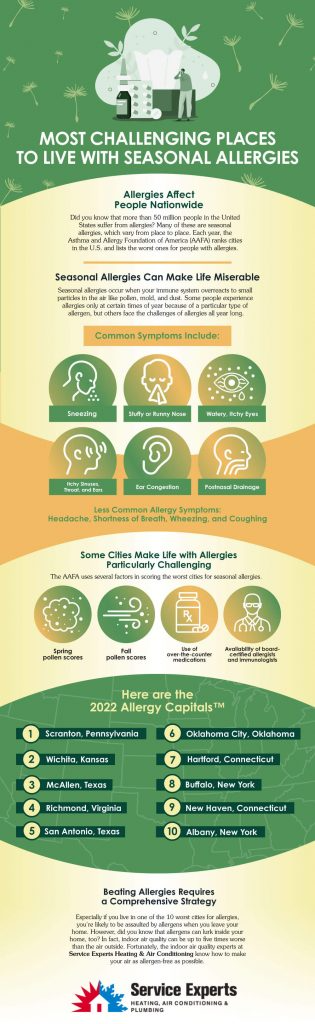
The 10 Cities in the United States With the Most Severe Fall Allergy Seasons
Often, your location has a significant impact on the severity of your fall allergy symptoms. Fall allergies are identified to be more serious in some areas of the country than others. For example, ragweed (one of the most widespread sources of allergy-inducing pollen) is concentrated in the country’s eastern region along with the Midwest. Nonetheless, allergies can be a considerable problem despite where you live. Here are the 10 toughest cities for those managing seasonal allergies.
Getting Help From Service Experts Heating, Air Conditioning & Plumbing
As you have now seen, the ideal strategy for dust mites and fall allergies involves an all-out assault on the pollutants and contaminants in the air within your home. Each home will need a specialized approach structured for that home’s unique makeup and layout. With air quality specialists all across the United States,Service Experts can help out in almost every corner of the country. If you're looking for one of our indoor air quality pros to help address as many sources of allergens as possible, call or fill out a contact form today.