
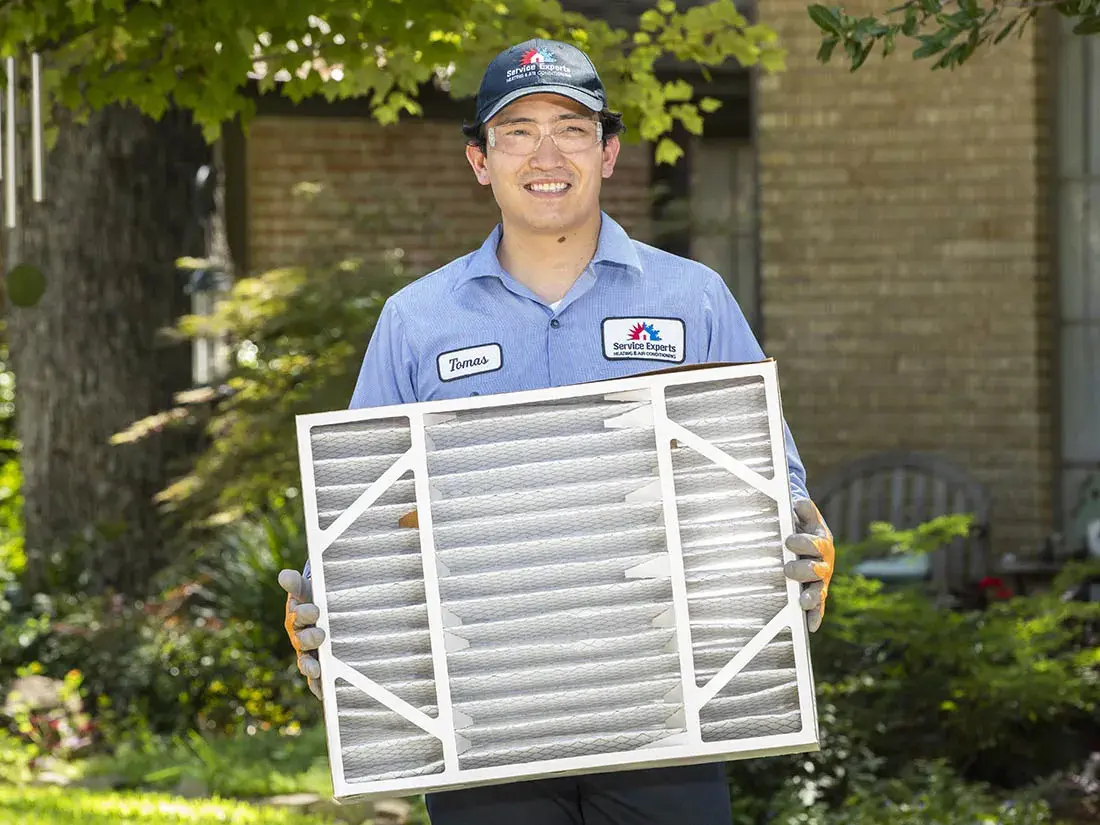
A minimum efficiency reporting value, or MERV, is a rating system created by the American Society of Heating, Refrigerating and Air-Conditioning Engineers (ASHRAE). MERV ratings signify an air filter’s effectiveness at decreasing airborne particles and pollutants. A filter’s rating is determined by the smallest particle it’s capable of trapping (measured in microns). As filters become better at improving indoor air quality, their MERV rating goes up, ranging from 1 to 20.
Below, you will see a chart that can help you determine the recommended MERV rating for a variety of settings.
| MERV Range | Controlled Contaminants | Typical Application | Air Filter Types |
| 1-4 | Pollen, Dust, Spray Paint, Dust Mites, Sanding Dust, Textile & Carpet Fibers | Residential, Window AC Units | Disposable Electrostatic |
| 5-8 | Mold Spores, Pet Dander, Hair Spray, Dusting Aids, Fabric Protector, Cement Dust, Pudding Mix | Better Residential, Commercial, Industrial Workplaces | Pleated Filters Cartridge Filters Electrostatic |
| 9-12 | Legionella, Auto Emissions, Lead Dust, Humidifier Dust, Welding Fumes | Superior Residential, Better Commercial, Hospital Labs | Pleated Filters Cartridge Filters |
| 13-16 | Bacteria, Droplet Nuclei (Sneeze), Tobacco Smoke, Insecticide Dust | General Surgery, Hospital Inpatient Care | Bag Filters Box Filters |
| 17-20 | Viruses, All Combustion Smoke, Carbon Dust | Cleanrooms, Radioactive & Carcinogenic Materials, Pharmaceutical Manufacturing | HEPA Filters Specialized Filters |
Other Measurement Systems
Knowing about MERV ratings isn’t always enough when you need to buy a furnace filter. For example, some big retailers use the filter performance rating (FPR), which goes from 1-10 and measures a filter’s ability to trap large and small particles. You might also see the microparticle performance rating (MPR) system, which goes from 300 to 2200 and measures a filter’s effectiveness at trapping only the smallest particles on the MERV scale (0.3-1 microns in size).
Explore the chart below for more details about how filters ranked with FPR and MPR stack up to the more conventional MERV rating system.
| MERV Rating | FPR | MPR |
| MERV 1-5 | Below Minimum FPR | Below Minimum MPR |
| MERV 6 | Below Minimum FPR | MPR 300 |
| MERV 8 | FPR 5 | MPR 600 |
| MERV 11 | FPR 7 | MPR 1000-1200 |
| MERV 13 | FPR 10 | MPR 1500-1900 |
| MERV 14-20 | Above Maximum FPR | MPR 1900+ |
What Should My Furnace Filter’s MERV Rating Be?
Selecting the ideal MERV rating for an air filter is a delicate balance between an HVAC system’s capabilities and the indoor air quality you want to have.
For example, a better MERV rating won’t always mean that a filter is the right option for your furnace. In fact, as MERV ratings go up, air flow goes down—forcing your HVAC system to work harder to move air through your furnace, increasing the possibility of a potential breakdown. Before purchasing a new furnace filter, make sure to check if your HVAC system has a limit for MERV rating. If it has one, be sure to get a furnace filter with a MERV rating below your system’s limit.
If a family member has allergies or serious respiratory problems like asthma, you may want to get filters with stronger MERV ratings. Keep in mind, there are always other solutions out there to improve your indoor air quality if your system can’t accommodate the MERV ratings you need.
As a rule of thumb, our suggested MERV rating for furnace filters runs from 6 to 8 for a great balance between top furnace efficiency and home comfort.
Choosing the best MERV rating for a furnace filter has a major impact on your indoor air quality, your HVAC system and, most important, your family’s well-being. Let Service Experts help you make the best decision. We have a full line of air filtration solutions plus our Expert knowledge and service—and we’re available 24/7 for emergencies. Contact us at (866) 963-7996 to request your indoor air quality consultation in Canada today!